There Is No Root
On the Self-Generating Structure of Ignorance


I. The Search Is the Structure
You are already doing it.
Right now, before you have finished this sentence, the mind has moved, not toward anything in particular, but with the directional quality of something trying to locate itself.
Not lost exactly, just perpetually orienting, perpetually checking.
Call this what you want.
A tendency.
A habit.
The background hum of cognition.
But be precise. It is a specific operation, not a vague one.
The mind reaches toward a reference point, some ground, some root, some first cause for the fact of its own confusion, because it has already decided, without deciding, that confusion must have a cause locatable within the same framework that produced the confusion. This is mūla avidyā, root ignorance. Not in the sense of an original sin buried in the past, but in the sense of a root that grows downward from every point simultaneously, which is to say, not a root at all.
The word will become strange before this is over.
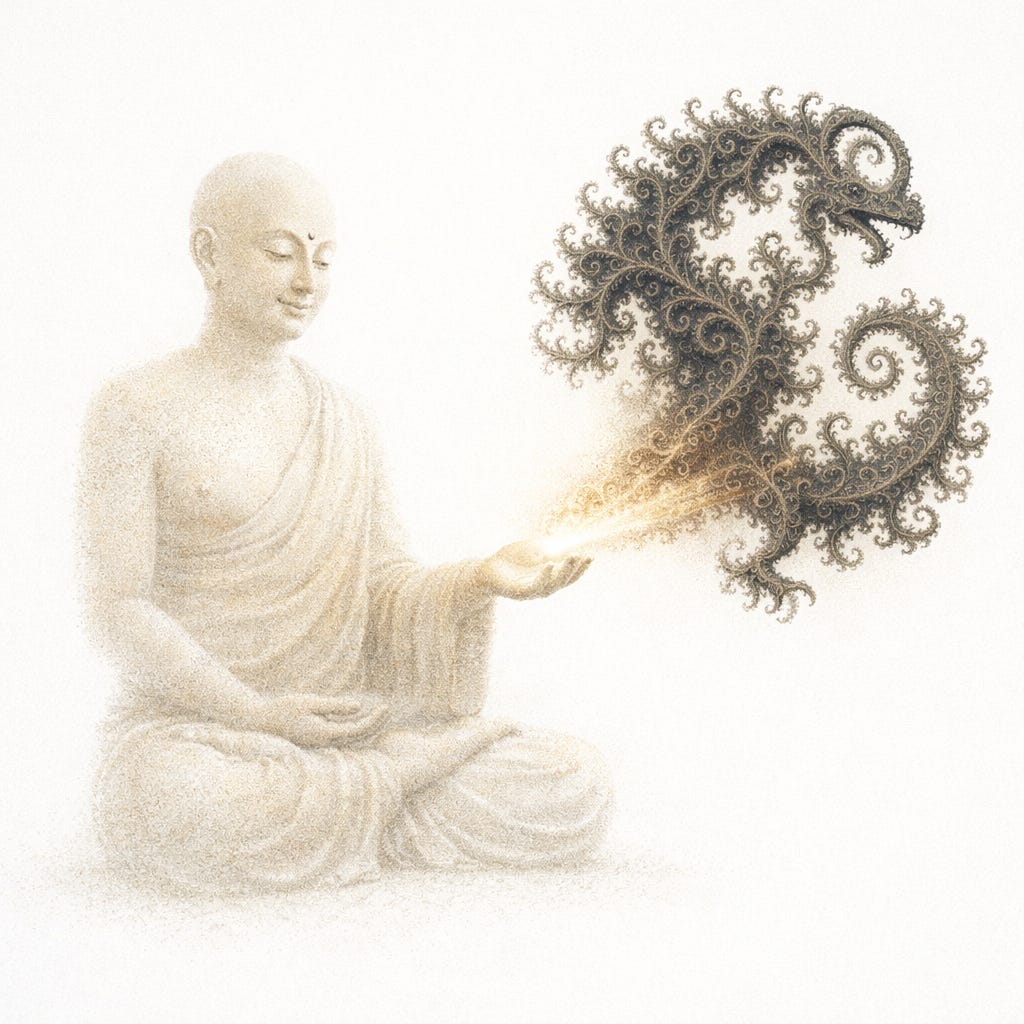
There is no root to find. The search for the root is the root. Not metaphorically, structurally. The movement toward a first cause is the first cause. It regenerates the very thing it claims to seek. This is not a paradox to be resolved. It is a description of what is actually happening, in the same way that describing a whirlpool does not require explaining what water should do instead.
Tṛṣṇā, thirst, craving, the self referential hunger, produces its own object. The seeking validates the sought. The question “where does this come from?” is not neutral. It smuggles in an answer. It comes from somewhere. And now the apparatus is running.
II. How Immediacy Gets Divided
There is something prior to the question. Prior to the habit. Prior to the search.
Try to catch it, not as an instruction toward liberation, but as a purely phenomenological act. Before the sound is heard, there is the happening of sound. Before the thought is thought, there is its arising. Before the sensation is felt, there is the sheer pressure of sensation occurring. This is sphurana, the primordial throb, the first pulse of arising before any differentiation has taken place. Kashmir Śaiva thought names it because the naming itself is a kind of pointing. Not toward somewhere else. Toward what is already the case before the pointing begins.
The Tāntric linguists called the silence prior to speech parā vāk, the supreme unsounded word, the ground of all levels of language. Not a special silence. Not a mystical silence. The ordinary silence that is simply the condition of sound. And then sound. And then, a fraction after, a fraction so small it is not a fraction but a structural layering, the move. I hear.
This is the operation to watch.
Raw occurrence, the sheer happening, prior to any coordinate, exists, if that is the right word, in a field that is not yet divided into who is experiencing and what is being experienced. Nirvikalpa, without conceptual construction, without the imposition of name and form. Not an achievement, not a state to be sought, not an altered condition. The condition prior to the alteration that is ordinarily called normalcy.
And then the fold. Nāmarūpa, name and form, the structural dyad through which raw occurrence is divided into locator and located. The field becomes a field for someone. The hearing becomes my hearing. The arising thought becomes my thought. Not because anything changed in the thought, but because the reflex has fired. The locating has happened. The coordinate has been installed.
Śaṅkara called this adhyāsa, superimposition, the overlaying of one order of reality upon another. The map over the territory. The coordinate over the occurrence. The error is not that the coordinate appears, that may be unavoidable, may be what a nervous system does, but that the coordinate and the occurrence become fused so completely that the occurrence seems, retroactively, to have required the coordinate in order to be real. Māyā is not illusion in the simple sense of something false. It is the projective power that makes the superimposition appear not only real but self evident. Not, I have imposed a coordinate on raw occurrence, but, of course there is a me who heard. What else could hearing be?
The conversion is not the occurring. It is not even the locating. It is the fusion, the moment the map is taken for the territory, the moment the coordinate is taken for the thing it was generated to describe.
III. Existence Defined as Continuity
Once there is a location, once the fold has happened and asmitā has been installed, the I amness, the subtle identification of pure being with a persisting subject point, a second assumption arrives, not as a decision but as a structural corollary so immediate it seems to have been there first.
The location must persist.
Not should. Not would be nice to. Must, because the definition of existence has already been revised quietly at the level of saṃskāra, the deeply grooved impressions that enforce continuity across moments. Existence is now defined as continuous locatability. To be real is to be findable here, now, and again in the next moment, and the moment after, with enough consistency that the same word can be used across all of them. Bhava tṛṣṇā, the craving for continued existence as a discrete, locatable entity, not clinging to life in some dramatic sense, but the prior and more intimate clinging, to being the kind of thing that can be said to exist at all.
Here is what follows from this, and it should be allowed to land with its full weight:
If the reference point cannot be located in the next moment, then what was located in this moment is retroactively unreal. The past moment is cancelled, not merely ended, but voided, stripped of its status as an occurrence that actually happened to a real someone. Anicca, impermanence, is not primarily the fact that things end. It is the structural pressure this definition of existence places on every moment. Any gap in the continuity is not just a gap, it is retrospective annihilation. Anattā, the absence of a fixed self, is not primarily a philosophical claim about what there ultimately is. It is what the system registered, before philosophy, as the central threat.
It is not, I fear I will die.
It is, existence is defined as continuous locatability, and anything that fails to be continuously located does not count as having existed. Abhimāna, self referential appropriation, and nityatā grāha, the grasping at permanence, are not psychological quirks, not cognitive biases to be corrected. They are structural necessities given the terms already in place. The system is not being irrational. It is being completely, ruthlessly logical about the implications of a definition it did not choose and cannot see.
This is the wound. Not the one described in spiritual literature as the wound of separation, not the poetic wound of exile from the divine. The operational wound, that the very definition of existing has been rigged in such a way that nothing can satisfy it, and nothing ever could, and the system already knows this, not consciously, but structurally, which is why the searching never stops.
IV. Every Solution Is the Root
There is no clean way to move through this section. The doors close as they are approached.
To seek the root confirms there is a root to seek. The directional hunger, tṛṣṇā, validates its own object by moving toward it. Every moment of sincere spiritual searching, every sitting down to meditate, every turning inward, every asking “what is this really?” is the structure enacting itself. This is not a reason to stop searching. It is a description of what searching is.
To resolve the root confirms there was a problem requiring a resolver, kartā, the agent function, now wearing the robes of the problem solver instead of the seeker, but structurally identical. The resolution reinstates the resolver. The liberation story requires a protagonist.
To transcend the root requires a higher position from which the root is below. This is jñāna abhimāna, the pride of transcendence, knowledge pride, the spiritual bypass that is not a bypass at all but the root wearing its most refined disguise. The claim “I have seen through it” is the most elegant recurrence. It carries the structure forward without any of the obvious markings of craving or confusion. It has graduated. It has not dissolved.
To accept the root, the move recommended in contemporary mindfulness discourse, the allowing and meeting with kindness, reinstates an accepter and an accepted. Sākṣī abhimāna, witness pride, the subtle identification with being the one who remains undisturbed. The witness is positioned. Positioned means located. Located means the structure is running.
To witness everything, including the acceptance, including the witnessing itself, without claiming any of it, here the move becomes almost invisible. But if the not claiming is registered as an achievement, if there is any quality of having successfully not claimed, the structure has regenerated through the very precision of the attempt. Jñāna abhimāna again, in its subtlest form.
To see all of this, to read this section and feel the particular recognition, the sense that yes, I see the trap, is the trap. The recognition is a location. The “yes” is a coordinate installed in the field of occurrence. Upādāna, grasping, does not require a gross object. The finest grasping is the grasping at the one who has stopped grasping.
The escape routes are not external. They are built into the architecture of the system that is looking for them. Prapañca, conceptual proliferation, expands through every operation directed against it.
V. State Cannot Perceive Structure
The problem is not that the answer is hidden. The problem is that the apparatus of looking is made of the problem.
In Advaita Vedānta, the distinction between vyāvahārika and paramārthika is not between two worlds. It is between a state and the structure that produces it. Every inquiry is a state. A state cannot perceive structure because perception itself is a state.
There is no external vantage. Every attempt to find one is already inside the structure.
Understanding this is also inside the structure.
VI. The Fractal and the Seal
Pratītyasamutpāda. Dependent co arising. Everything arises in dependence on conditions, including this sentence.
This essay is conceptual proliferation describing conceptual proliferation. It cannot escape that.
The structure is fractal. It recurs at every scale.
The root is not a thing. It is the assumption that occurrence must be owned.
That assumption is the operation of location itself.
And it is perpetuated by every movement toward or away from it.
Including this.
Including the noticing of this.
The light does not require a holder.
But the moment it is claimed, the structure continues.
Saṃsāra is not the world of suffering. It is the self sustaining cycle that generates its own continuation.
It does not need to be escaped.
It just runs.
It just runs.
And here we are, inside it, together, reading.